

New Publication: A multi-objective performance assessment of prototypical residential wall assemblies in the United States

A research publication resulting from the BEST Center project titled “Embodied Energy and Embodied Carbon Analysis of Residential & Commercial Building Envelopes” led by Prof. Wil Srubar III and Megan Quinn was recently published in the journal Energy & Buildings. From the paper abstract:
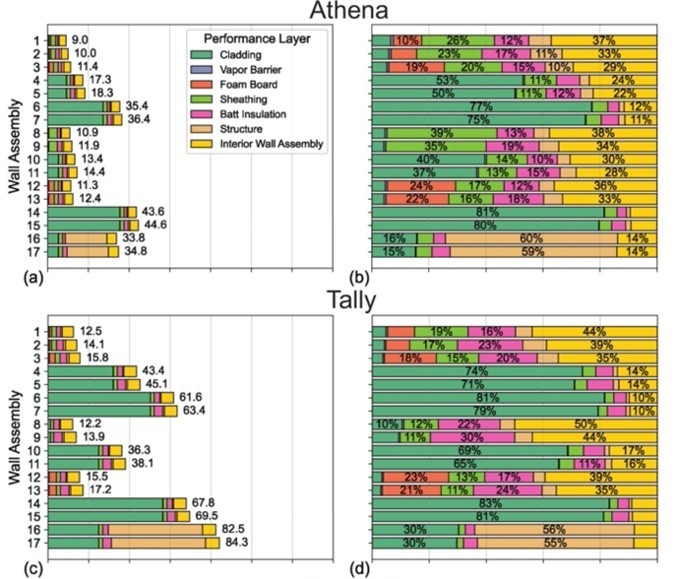
Residential buildings make up 90 % of the United States (U.S.) building stock. As new construction grows, early design decisions are critical to both environmental impact and functional performance. This study addresses the need for integrated trade-off analysis to inform sustainable material and assembly selection by considering the environmental (i.e., embodied carbon intensity (ECI) and embodied energy intensity (EEI)), economic (i.e., cost), and technical (i.e., thermal, acoustic) performance metrics for 17 prototypical residential wall assemblies in the U.S. Results show that ECIs and EEIs are highest for wall assemblies that incorporate high-density cladding or structural materials. However, these assemblies have favorable cost, thermal, and acoustic performance. Conversely, wall assemblies with low-density cladding materials have low embodied carbon and embodied energy intensities, though their cost, thermal, and acoustic performances can vary. A trade-off analysis was conducted
to further understand the relationship between performance metrics. Linear regression models were trained on each pair of metrics with positive linear correlations found between all design metrics except thermal performance. A multi-objective performance analysis revealed that the prototypical wall with 2×6 dimensional lumber and stucco cladding was most favorable across all performance metrics. The comprehensive multiobjective design methodology introduced in this study can inform the selection of high-performing residential wall assemblies that satisfy multiple design-decision trade-offs.