
New Publication: Quantifying energy benefits from window improvement strategies for commercial buildings

A research publication resulting from the BEST Center project titled “Feasibility Evaluation of Net-Positive Window Systems” led by Prof. Moncef Krarti, Prof. Michael McGehee, and Eric Ohene was recently published in the journal Energy and Buildings. From the paper abstract:
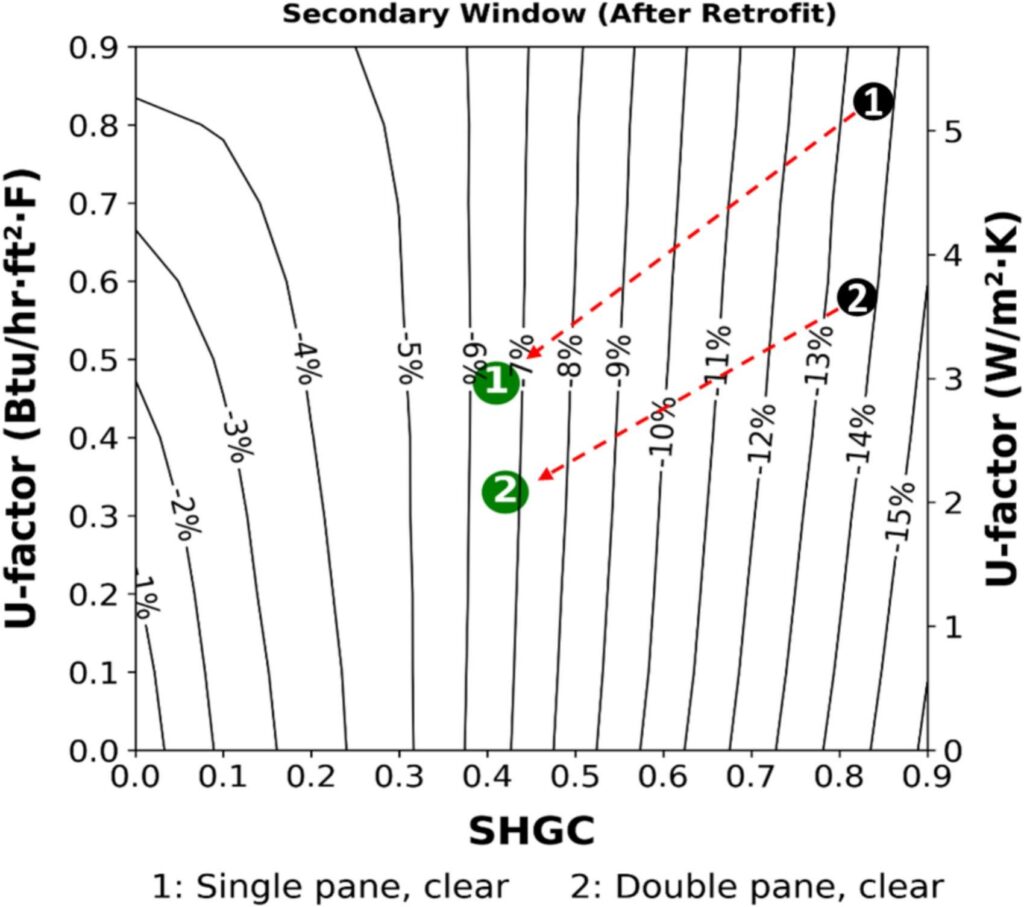
This study investigates the feasibility of net positive windows (NPWs) for office buildings. Specifically, a series of parametric and optimization analyses is conducted to determine the main design and operation parameters that affect energy efficiency of windows for prototypical office buildings across various U.S. climate zones. The analyses evaluate the impacts of glazing thermal and optical properties, window sizes, and shading strategies on the energy performance of office buildings with and without daylighting controls. It is found that achieving NPWs is challenging especially for office building with large windows located in hot climates. The analysis indicates that achieving NPWs can only be feasible for static windows when a combination of integrated design and operation strategies are considered including optimized thermal and optical properties for the glazing coupled with tight air leakage and enhanced daylighting controls. For retrofit applications on static glazing, secondary windows provide 6% and 5% energy saving when applied to single pane and double pane windows, respectively. Energy saving for Low-E film applications are estimated to be 8% for single-pane windows and 7% for double-pane windows. Internal shades reduce the annual energy use of the office building by 8% for single pane and 3% for double pane windows, whereas external shading provided 8% annual energy saving for single pane windows and 7.9% for double pane windows.